.png)


The dynamic nature of uniformity: tracking variation from hatchery to slaughter
In commercial broiler production, flock uniformity, the degree to which individual birds within a flock match in body weight is a critical metric influencing both biological performance and economic profitability. Far from being a static characteristic, uniformity is a dynamic parameter that continuously evolves from the moment an egg is set in the incubator until the bird reaches the slaughter line. Understanding this trajectory of variation, and the factors that influence it, is paramount for implementing effective management strategies, particularly gender sorting, to maintain optimal flock consistency.
Understanding CV% in broilers: key drivers of uniformity variation over time
The central insight is that uniformity variation follows a predictable progression, with different factors exerting influence at various stages of the broiler's life. While the Coefficient of Variation (CV%) typically ranges from 10% to 15% at market age, this final figure is the cumulative result of multiple interacting elements throughout the bird's lifespan. A lower CV% signifies a more uniform flock, directly correlating with improved feed conversion, reduced mortality, and higher processing plant yields. Crucially, environmental stressors, social competition, and disease challenges generally cause the CV% to widen over time, making early interventions vital.
Relative sources of body weight variation by production stage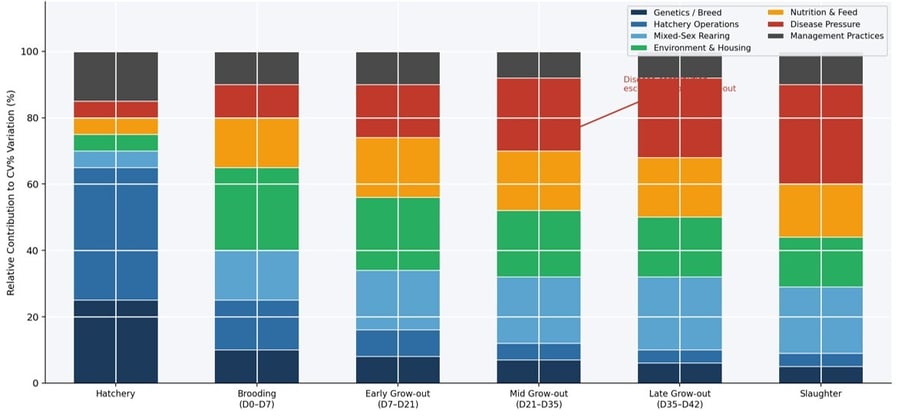
How hatchery, health, and management impact broiler uniformity
Supporting data illustrates this progression clearly. At hatch, the CV% is largely determined by factors such as breeder flock age and incubation conditions. However, as birds grow, the primary drivers of weight variation shift. In the early brooding phases, genetics and hatchery operations dominate. By mid-to-late grow-out, the impact of mixed-sex rearing, environmental stress, and disease pressure becomes the overwhelming source of variation. For instance, flocks managed under excellent conditions, including gender sorting and optimal health, can maintain a CV% below 8% through to slaughter. Conversely, flocks encountering significant disease challenges, such as Infectious Bursal Disease (IBD) or Coccidiosis, can experience a sharp divergence in uniformity, often exceeding a CV of 15% by late grow-out.
Gender sorting in broilers: a key strategy to improve uniformity and reduce CV
The imperative of gender sorting becomes evident in this context. Male and female broilers possess markedly different growth rates and nutritional requirements. When reared together in mixed-sex flocks, faster-growing males tend to dominate feeders, leading to females being undernourished and artificially inflating the flock's CV%. By separating sexes at day one and implementing sex-specific feeding programs, the bimodal weight distribution characteristic of mixed-sex flocks is eliminated, resulting in a significantly tighter CV% throughout the grow-out period. This early intervention sets a stable foundation that is difficult, if not impossible, to recover later, regardless of subsequent management efforts.
Optimizing broiler profitability through uniformity and early management strategies
The clear takeaway is that proactive management of uniformity variation is essential for broiler profitability. Gender sorting at the hatchery is a fundamental element for CV% improvement and is a must-have to unlock the broiler business potential. By understanding and addressing the dynamic sources of variation from the earliest stages, producers can maintain a tight CV%, ensuring predictable bird sizes for processing, maximizing yields, and ultimately enhancing the economic viability of their operations.

.jpg)